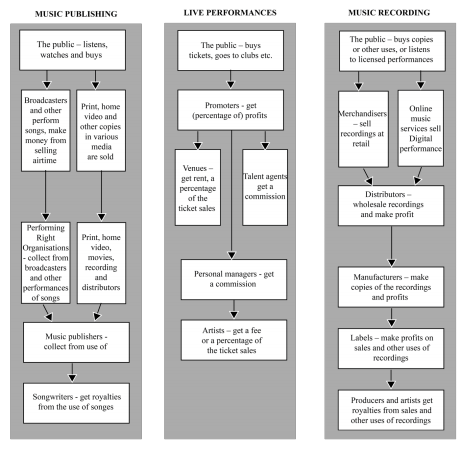
In music business, there are three revenue streams – one generated through the utilization of a song, one generated from live performances of that song, and one from the utilization of a particular recorded performance of that song.
At the head of each revenue stream is a creative act – a song is written, a live performance given, or a recording is produced. The publisher exploits the composition, but it is the writer who creates it. These creative acts give rise to legal rights associated with the acts. The songwriter’s creative act results in copyright in a musical composition. So this stream is referred to as the songwriting tream.
Performers have a right to keep others from recording or broadcasting their performances. The record label, producer, and recording artist’s creative acts result in copyrights in sound recording. Three distinct legal rights, three distinct creative acts, and three distinct treatments of a song produce three distinct income streams.
The presence of cash flow in three streams drives the major players in the industry to try to gain control over and participate in all three income streams with measures such as the 360 deal. In such a deal, an artist signs an agreement for all (or most) music business functions with the same entity, be it a label or other entertainment entity.
Source: Hull, Hutchinson & Strasser, 2011, p.44
However, this is the traditional revenue streams model in music industry. It becomes more more more complex in real life in the face of the emergence of new digital technologies, which have transformed virtually every corner of the music industry for fans and creators alike. In the next post, I will learn and report on how musicians and songwriters are compensated when their music is played on the radio, sold on digital platforms, webcast or streamed on interactive services (most likely the US-based) ^^
Source: Hull, G. P., Hutchison, T. W., & Strasser, R., 2011, The Music and Recording Business, p125-138.
 Muniverse